
Who Clears Land in Sussex County, DE? Hiring & Licenses
Who clears land in Sussex County, Delaware? Land clearing and site-work contractors, forestry mulching operators, excavating companies, and tree services all handle parts of it, and some jobs need more than one. Delaware's Division of Professional Regulation doesn't list land clearing among the trades it licenses, but every contractor doing business in the state needs a Delaware business license, and some of the work around a clearing job, like septic installation and surveying, is licensed. This guide covers how to look a contractor up, what to ask, and what belongs in writing.
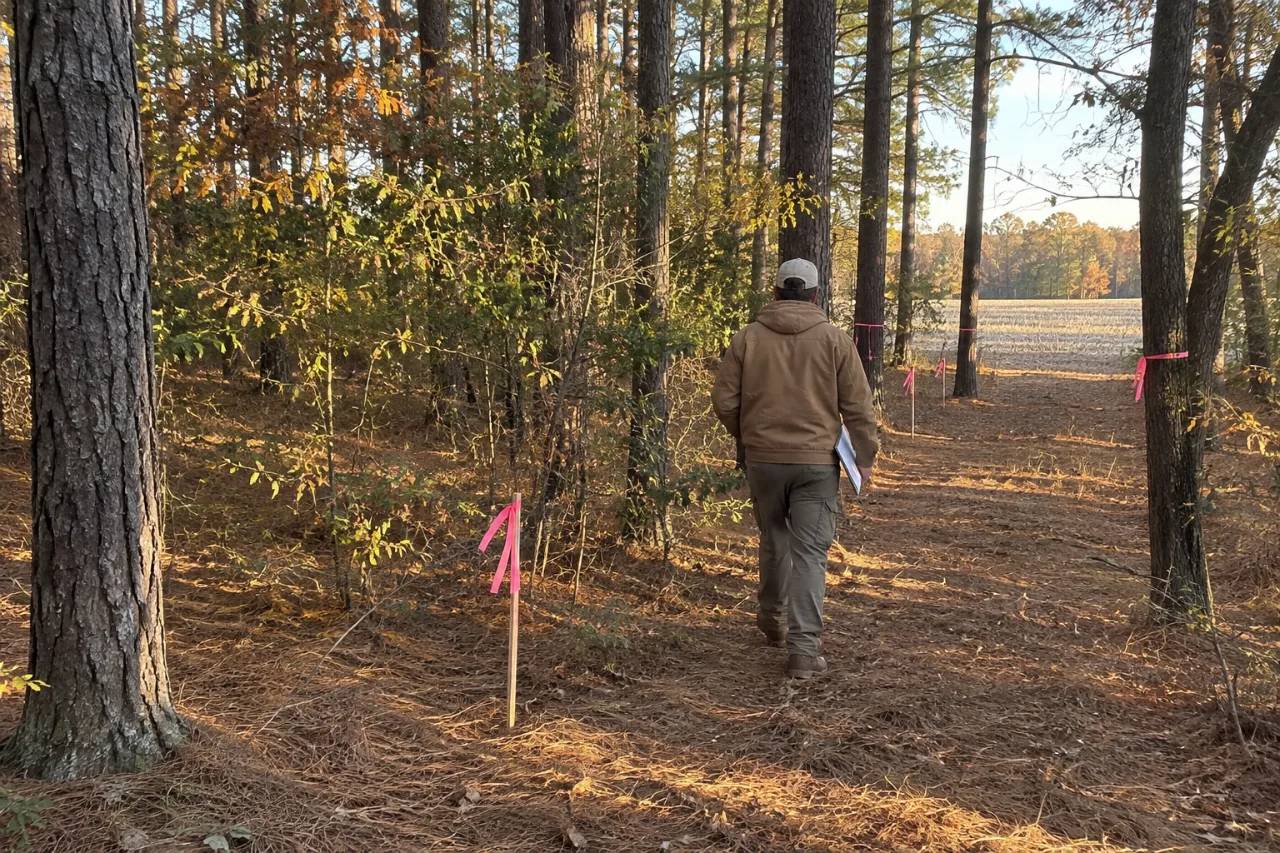
Who does which part
- Land clearing and site-work contractors cut, grub, pull stumps, and often grade the pad and drive.
- Forestry mulching operators grind brush and small trees in place with a mulching head.
- Tree services take down trees close to houses, wires, and fences, often by climbing or with a bucket truck.
- Loggers and timber buyers harvest merchantable timber; the Delaware Forest Service keeps buyer lists and a Wood Buyers Directory.
- Licensed specialists come in around the clearing: a Class D soil scientist for the septic site evaluation, a licensed designer and Class E contractor for the system, and a licensed land surveyor for lines and corners.
The Delaware business license
The Division of Revenue's contractors page is direct: "Any contractors conducting business activity in Delaware are required to register with and obtain a business license from the Delaware Division of Revenue." It has separate registration packages for resident and nonresident contractors, and the nonresident forms include a bond. That can matter in Sussex County, which borders Maryland, if a contractor is based across the state line. You can check any business on the Delaware business license search. The Business Tax office is at (302) 577-8780.
Which trades Delaware licenses
The Division of Professional Regulation lists its boards, and the ones that touch a building project include electrical examiners; plumbing, heating, ventilation, air conditioning, and refrigeration examiners; professional land surveyors; landscape architecture; geologists; and manufactured home installation. Land clearing, excavation, and tree work aren't on that list.
Septic work is licensed through DNREC instead. Its septic systems page names licensed Class D soil scientists for site evaluations, Class B and Class C designers, and Class E system contractors for installation. DNREC's water contacts list Groundwater Discharge Licenses and water well contractor licensing at 302-739-9945. For herbicide work on regrowth, questions go to the Delaware Department of Agriculture's pesticide line, 302-698-4571.
Contractors are responsible for their own licensing and insurance. What you can do is look them up, ask for proof, and keep copies.
Insurance to ask about
- A certificate of general liability insurance, sent to you by the contractor's insurance agent, with you listed as the certificate holder.
- Workers' compensation coverage if they have employees on your land, or a written statement about how their workers are covered.
- Commercial auto coverage for trucks and trailers hauling equipment and debris on public roads.
- The policy dates, so you can see the coverage runs through the job.
Questions to ask before you hire
- What's your Delaware business license name and number?
- Who gets the Residential Standard Plan from the Sussex Conservation District, and who puts in the silt fence and stone entrance?
- Where will the brush, logs, and stumps go, and are drop-off fees in the price? (Burning isn't an option on a building lot.)
- Who requests the Miss Utility locate, and how will private lines like the well and septic be found?
- Is any of the work inside a tax ditch right-of-way or near a wet area, and how will you handle it?
- How big a tree can your mulcher take, and what gets cut with a saw first?
- How will you keep machines from rutting low ground, and what happens on wet days?
- Is seed and straw on bare ground included, and when?
- How many days do you expect, and when can you start?
What the written agreement should cover
- The area, on a sketch or flagged on site, and every tree, line, and area to leave alone.
- The method for each area, and what happens to stumps.
- Where debris goes and who pays for it.
- Who handles the plan, the locate, and any DelDOT entrance permit.
- Erosion controls and stabilization.
- Price, what counts as extra, payment schedule, and the start window.
- Proof of insurance and the business license number.
- Cleanup at the end, including the road and the entrance.
Red flags
- An offer to burn the brush from a house lot. DNREC prohibits it.
- Being told a house lot doesn't need a plan when the work will pass 5,000 square feet.
- Plans to push stumps or brush into a tax ditch right-of-way, a ditch, or wet woods.
- No Delaware business license, or reluctance to share the name it's under.
- A large cash payment before any work, or a price that won't go in writing.
Selling timber first
On a bigger wooded tract, the timber may be worth selling before clearing. The Delaware Forest Service can help "by providing sample timber sale contracts and lists of potential buyers," and while its staff can't appraise timber, it keeps a list of consultant foresters who can. Operators and buyers must give the Forest Service written notice at least 10 business days before a harvest of an acre or more.
Hiring questions
Is a tree service the same as a land clearing contractor?
They overlap. A tree service is set up for removals near houses and wires; a clearing contractor brings machines for acreage, stumps, and grading. A house lot with big trees beside a neighbor's home can use both.
Does a Maryland contractor need anything to work in Delaware?
The Division of Revenue requires any contractor doing business in Delaware to register and hold a Delaware business license, and it has a nonresident contractor package with bonding forms. Business Tax: (302) 577-8780.
Does an owner clearing their own land have to follow the same rules?
The plan rule, the burning rules, and the wetland and tax ditch limits apply to the land and the work, whoever runs the machine.
The lowest bid leaves out hauling. Does that matter?
Yes. On a lot where burning is off the table, where the debris goes can be a real part of the cost. Compare quotes on the same scope, debris included.
How the referral works
When you send a request, one independent contractor who takes work in your part of Sussex County gets it, sees the land, and gives you a written price. Everything on this page still applies: look them up, ask questions, and get it in writing before you decide. The referral costs you nothing.
Have land in Sussex County that needs clearing?
Call or send a few details. One independent contractor gets your request, and the referral costs you nothing.