
Lot Clearing in Sussex County, DE
Lot clearing in Sussex County, Delaware usually starts with a flat, sandy parcel grown up in loblolly pine, sweetgum, red maple, and American holly, and ends with a house pad, a driveway, and room for a septic system. The county keeps building: Census QuickFacts lists 3,885 building permits for 2025. A wooded lot here also comes with rules that surprise people, such as a Residential Standard Plan before any digging and a state ban on burning the brush. This guide puts each step in order, with the office that decides it.
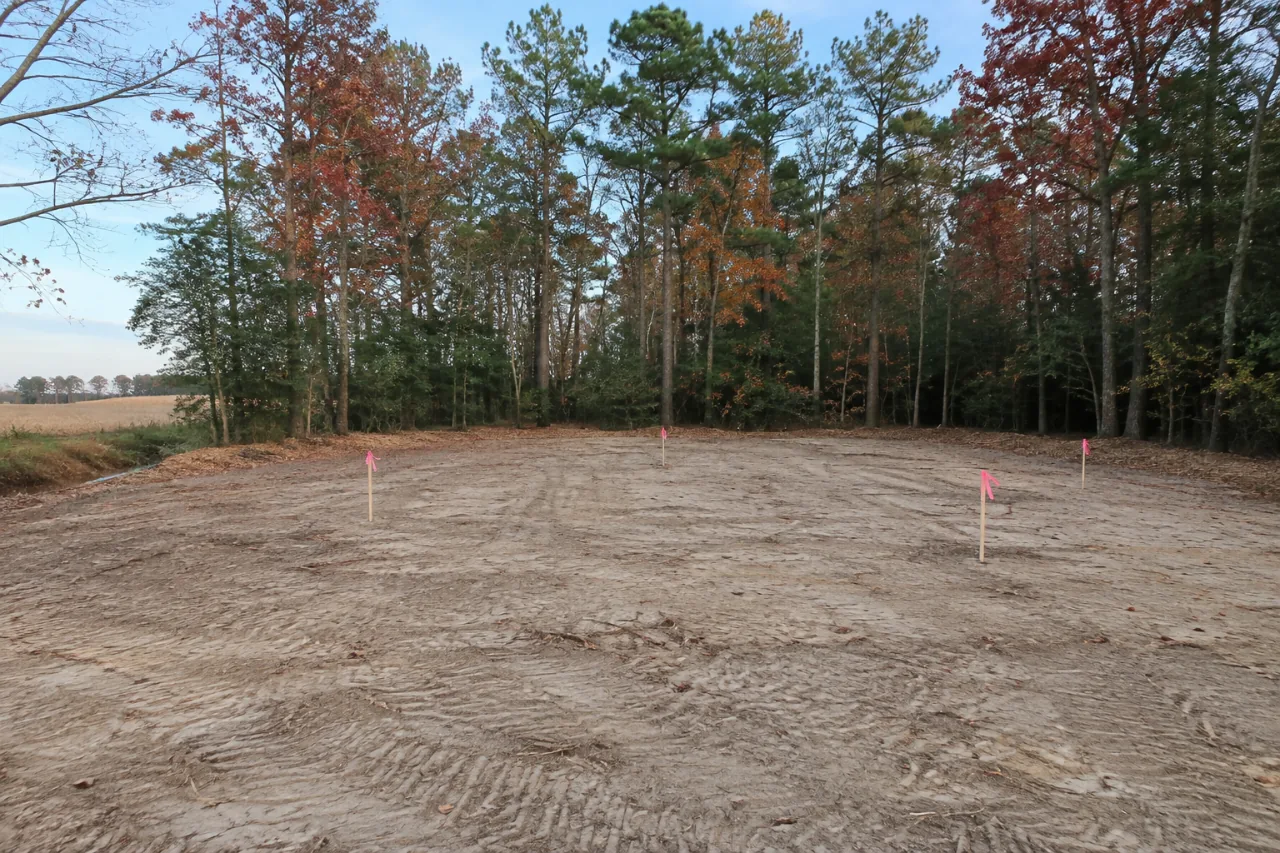
Clearing a house lot, step by step
- Find the corners. Have the lines and corners marked so nobody clears a neighbor's trees. Land surveyors are licensed through Delaware's Division of Professional Regulation.
- Check setbacks. Sussex County Planning & Zoning, (302) 855-7878, gives zoning information for building permits, including how far a house must sit from the lines.
- Septic, if there's no sewer. A licensed Class D soil scientist does the site evaluation, then a licensed designer draws the system and gets the permit.
- Residential Standard Plan. For 5,000 square feet of disturbance or more, get it from the Sussex Conservation District before any site work.
- Driveway entrance. A new entrance onto a state-maintained road needs a DelDOT entrance permit; the South District office in Georgetown is at (302) 853-1340.
- Miss Utility. Call 811 at least 2 full working days, and no more than 10, before digging or grubbing.
- Controls in. Put in what the approved plan calls for, such as silt fence on the low side and a stone construction entrance.
- Clear and grub the footprint, drive, septic area, and working room. Mulch or keep the rest.
- Debris out. Ground, chipped, mulched, or hauled. Not burned.
- Cover the ground. Seed and mulch bare soil; state rules give 14 calendar days to stabilize disturbed areas.
The 5,000-square-foot line
Sussex County's notice on the Residential Standard Plan requirement says that since January 1, 2017, projects disturbing "5,000 square feet or more" need a sediment and erosion control plan, and that this covers "residential single family home construction." The county calls the plan "a requirement for obtaining a building permit in Sussex County and prior to initiating any site disturbance." Apply through the Sussex Conservation District online or at 23818 Shortly Road in Georgetown. The notice lists a $100 fee (the district's online application showed $135 when checked in October 2026, so confirm it), approval "is typically received within 24-48 hours," and the district's stormwater program answers questions at (302) 856-2105.
How fast a lot reaches that line. Five thousand square feet is a little over a tenth of an acre. A 50-by-70-foot area for a house and garage is 3,500 square feet; a 12-by-150-foot driveway adds 1,800, for 5,300 before the septic area or a yard is counted (our arithmetic).
The state Sediment and Stormwater Regulations exempt work that "disturbs less than 5,000 square feet," but separate small disturbances that add up to more are not automatically exempt. Clearing a lot in pieces doesn't get around the plan.
When more than an acre gets disturbed
Bigger lots bring more paperwork. Under the state regulations, "construction projects exceeding 1.0 acre of total disturbance require submittal of a Notice of Intent," the filing for coverage under Delaware's construction stormwater general permit, along with a plan that meets pollution-prevention requirements.
DNREC's standard plan for residential lots of an acre or more fits a single house lot that won't create common open space or a public street, with no more than 5.0 acres disturbed on any individual lot. It adds a forest condition: clearing of forest areas "will not exceed 1.0 acre," or else equivalent forest area has to be kept on the parcel for whatever clearing goes past that acre. That form lists a $500 review fee, but it's for plans DNREC reviews itself; in Sussex County, the Conservation District's residential standard plan application covers lots over an acre too. Ask the district, (302) 856-2105, which application and fee your lot needs.
Septic first on most rural lots
DNREC describes a new septic approval as "a three-step process": a site evaluation by a licensed Class D soil scientist, a design and permit from a licensed system designer (Class B for gravity systems, Class C for engineered or pressure-dosed ones), and installation by a licensed Class E system contractor. DNREC's septic systems page lists 302-739-9947 for the program.
The evaluation can decide where the house goes, so clear for it first: a light pass that opens paths and sight lines. Ask the soil scientist where machines should stay off until the work is done, and flag that ground for the contractor.
Higher ground is often loamy sand: NRCS describes the Henlopen and Rosedale series, whose reference sites are both in Sussex County, as brown to light yellowish-brown loamy sand over sandy loam, under woods of white oak, sweetgum, loblolly pine, and American holly. Low flats and swales can be Fallsington soils, which NRCS rates poorly drained; their seasonal high water table sits within 12 inches of the surface from December through May. If part of your lot stays wet in spring, read wet lots and tax ditches first.
The forest ordinance and a single lot
Sussex County Council adopted its first forest preservation ordinance on September 1, 2026, with the rules taking effect three months after adoption. WHYY's report on the adopted version says it applies to new subdivision applications and requires developers to keep at least 30 percent of the forest on land in growth areas, or 50 percent in rural areas, as drawn on the county's Future Land Use Map.
If you plan to split land, or you're not sure whether your lot belongs to a pending application, ask Planning & Zoning at (302) 855-7878 before the saws start.
Why the brush can't be burned
DNREC's open burning rules list "burning material generated from land clearing, except for agriculture" among the things that are always prohibited. The farm exception "does not include clearing land in order to construct structures," and DNREC's agricultural burning page adds that burning can't clear land where dwellings or other structures are built within five years. So brush, tops, and stumps from a house lot get mulched, ground, chipped, or hauled. Debris without burning covers each option.
What lot clearing costs
Angi's national land clearing guide (checked October 2026) lists $250 to $2,800 to clear a half acre: $250 to $1,000 when it's lightly forested and $1,800 to $2,800 when it's dense. For a full acre it gives $500 to $2,000 light and $3,600 to $5,600 dense. Add the plan fee and any hauling. These are national numbers, not Sussex County prices; the one that counts is the written quote from a contractor who has walked your lot. The cost guide has more.
Lot clearing questions
Can clearing start before the building permit?
Not for a job at 5,000 square feet or more. Sussex County requires the Residential Standard Plan before a building permit and before "any site disturbance." The county's Building Permit Office is at (302) 855-7720.
How much of a wooded lot should come down?
Usually just the footprint, the drive, the septic area, room for equipment, and the yard you want. Every stand of pines you keep is ground you don't have to stabilize or mow, and on bigger lots it keeps forest clearing under the one-acre condition in the state's standard plan.
Does underbrushing a quarter-acre lot need a plan?
A quarter acre is about 10,900 square feet, so it's over the 5,000-square-foot line if the work counts as disturbing land. Whether mowing or mulching brush while leaving the roots counts is a question for the Sussex Conservation District, (302) 856-2105, before work starts.
Why does a small lot cost more per acre?
Moving a machine to the lot costs about the same whether it works two hours or two days, so a small job carries more of that cost per acre. Expect a minimum charge.
How the referral works
Send the road the lot is on, its rough size, what's growing on it, whether the soil scientist has been out, and whether the Residential Standard Plan is in hand. One independent contractor who takes lot clearing work in your part of Sussex County gets the request, looks at the lot, and gives you a price in writing. Hiring them is your call, and the referral costs you nothing.
Have land in Sussex County that needs clearing?
Call or send a few details. One independent contractor gets your request, and the referral costs you nothing.