
Land Clearing Debris Without Burning in Sussex County, DE
In Sussex County, Delaware, land clearing debris from a house lot can't just be piled and burned. State rules ban burning land-clearing material unless the clearing is for agriculture, and even the farm exception has limits. That shapes every clearing job here: brush, tops, logs, and stumps get mulched where they stand, ground into chips, kept as firewood or timber, or trucked to a yard-waste site. This page sets out the rule in DNREC's own words and then each way to deal with the wood instead.
The rule, in DNREC's words
DNREC's open burning page lists three things as always prohibited: "burning waste and garbage," "burning fallen leaves and grass clippings," and "burning material generated from land clearing, except for agriculture." On top of that, "most open burning is prohibited in Delaware from May 1 through September 30," the ozone season, and all open burning is off on Air Quality Action days. The State Fire Marshal can also ban burning in a county, and the National Weather Service can issue red flag warnings.
Outside the season, homeowners may burn "cut or fallen branches, limbs, or shrubbery from their residence" after notifying the county fire board. That covers a pile of limbs from around a house, not the trees from a lot. For questions, DNREC lists the Division of Air Quality at 302-739-9402 and the Sussex County Fire Board at 302-856-6306.
The farm exception and where it stops
DNREC's agricultural burning page lets farmers burn "for crop residue, field maintenance, and land clearing for agricultural operations," including clearing "previously uncultivated land for the establishment of a new agricultural practice." Three limits matter for anyone clearing land:
- It "does not include clearing land in order to construct structures," even structures used with farming. DNREC's burning guide says vegetation from clearing "for the construction of structures" can't be burned, so clearing a pad for a poultry house or a barn is out.
- Burning can't be used to clear land where houses or other structures are built within five years.
- Agricultural burning is "prohibited statewide during the ozone season, from May 1 through Sept. 30 each year."
Where it does apply, the steps are set: apply online through DNREC's ePermitting system with a specific burn date, allow five to seven business days, wait for written approval by email, notify the county fire board with your approval number, and burn only between 8 a.m. and 4 p.m. DNREC's guide warns that staff inspect and measure piles, and that burning without approval can bring fines or criminal charges. Field edges and hedgerows covers farm clearing in more detail.
Option 1: mulch it where it stands
For brush and small trees, a forestry mulcher is usually the simplest answer on a no-burn site. It shreds standing growth into chips on the spot, so nothing gets piled, loaded, or hauled. It leaves stumps and roots, which is fine for woods, yards, and field edges but not under a house or a driveway. See forestry mulching.
Option 2: grind or chip it on site
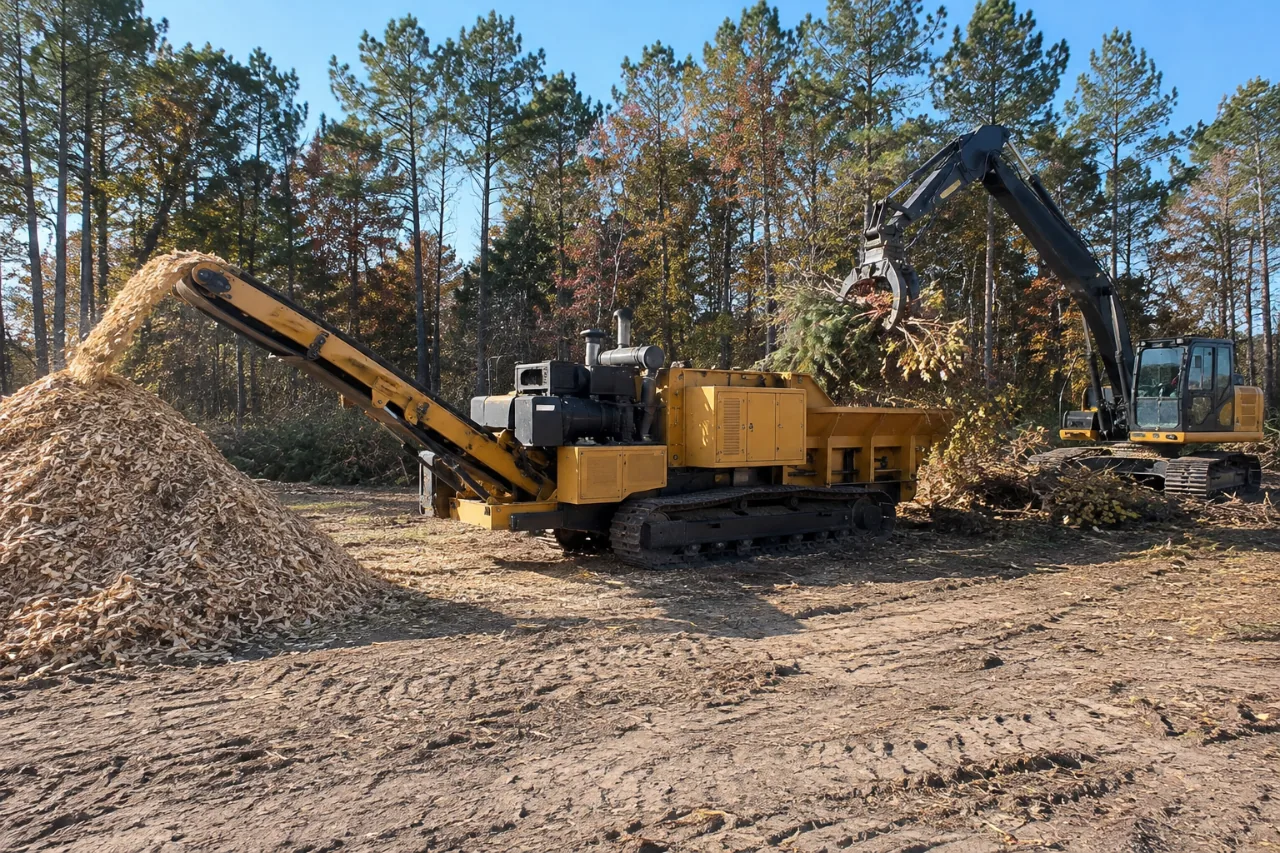
When trees are cut and piled, the pile can be turned into chips right there. A chipper handles limbs and tops; a horizontal or tub grinder takes whole tops, larger limbs, and stumps, fed by a machine with a grapple. The chips can be spread on paths and bare areas, kept for landscaping, or loaded and hauled, which is much easier than hauling loose brush. Ask where the grinder will sit and how the chips will be kept off the road and out of any ditch.
Option 3: haul it to a yard-waste site
DNREC says plainly that "yard waste is banned from all Delaware landfills," so brush can't go out with the trash. Its yard waste drop-off list for Sussex County includes Delaware Solid Waste Authority stations in Bridgeville, Ellendale, Long Neck near Millsboro, Omar near Frankford, Harbeson (Route 5), and Milford, the Jones Crossroads Landfill near Georgetown, and several private yards. Sites differ on whether they take stumps and logs, and rules and fees vary, so check each listing. DNREC adds that the list "is not meant to be exhaustive nor an endorsement."
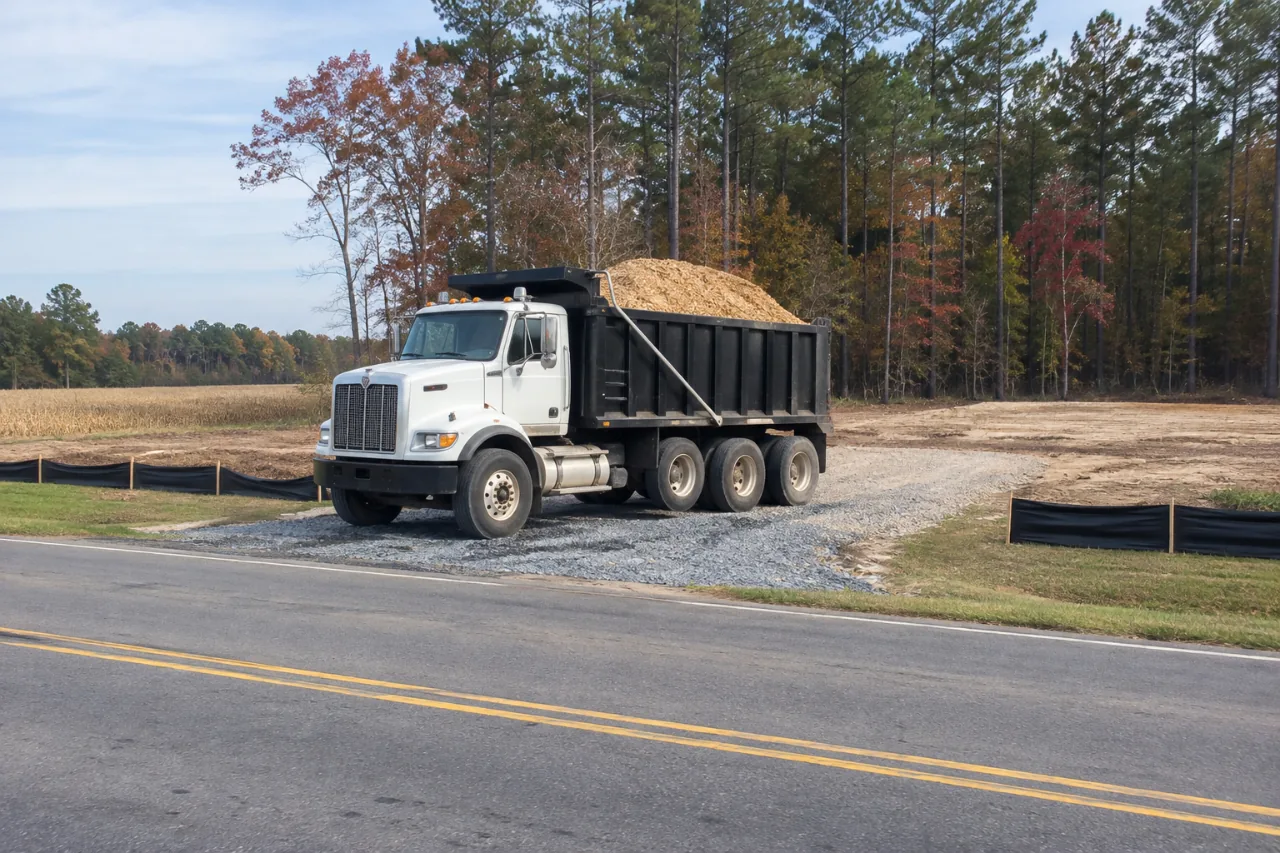
DSWA's own yard waste page lists brush, shrubs, and "tree limbs up to 4 inches in diameter," and says yard waste can't be mixed with regular trash. Ask before taking trunks or stumps to any site. Hauling adds truck time and drop-off fees to a quote, so it's worth knowing which site a contractor plans to use.
Option 4: keep or sell the wood
Straight logs make firewood, and a stand of merchantable pine on a bigger tract may be worth selling before clearing starts. The Delaware Forest Service helps landowners with timber sales "by providing sample timber sale contracts and lists of potential buyers," keeps a Wood Buyers Directory, and has a list of consultant foresters who can appraise timber (its own staff can't). Under the Forest Service's erosion regulations, operators and buyers give written notice at least 10 business days before a harvest of an acre or more.
Stumps
Stumps are the hardest part of the debris. They can be ground in place below the surface, or dug out and then ground or hauled. One exception: inside a tax ditch right-of-way, DNREC allows trees to be flush cut but says stumps can't be removed. Stump grinding and wet lots and tax ditches have the details.
What the quote should say about debris
- The method for each part of the job: mulched in place, ground on site, or hauled.
- Where hauled material is going, and who pays the drop-off fees.
- What happens to stumps, and whether stump holes get filled.
- Where chips end up, and that they stay out of ditches and tax ditch rights-of-way.
- How mud and chips are kept off the road. DNREC's residential standard plan restricts access to a stabilized construction entrance "to prevent vehicles from tracking mud onto roadways."
Debris questions
Can brush from a house lot be burned in winter?
No. The season isn't the problem. Burning land-clearing material is prohibited year-round unless it's agricultural, and agricultural burning can't clear land where houses are built within five years.
Can a farmer burn a cleared hedgerow?
Possibly, as agricultural burning, with written approval from DNREC, outside May 1 through September 30, between 8 a.m. and 4 p.m., and after notifying the Sussex County Fire Board (302-856-6306). The five-year rule still applies if a house will go there.
Can brush go in the trash or to the landfill?
No. Yard waste is banned from all Delaware landfills, and DSWA says it can't be mixed with regular trash. Use a yard-waste drop-off site from DNREC's list.
Is a backyard fire pit treated differently?
Recreational fires such as campfires, cooking fires, and patio fire pits are on DNREC's allowed list, but they're not a way to get rid of a lot's worth of brush, and all burning stops on Air Quality Action days.
How the referral works
Tell us what's coming down, roughly how much, and how you'd like the wood handled, if you know. One independent contractor who clears land in your part of Sussex County gets the request, looks at the site, and prices the clearing and the debris in writing. Hiring them is your decision, and the referral costs you nothing.
Have land in Sussex County that needs clearing?
Call or send a few details. One independent contractor gets your request, and the referral costs you nothing.