
Stump Grinding & Removal in Sussex County, DE
Stump grinding in Sussex County, Delaware is usually the last step of a clearing job or the first step of a new yard: pine and sweetgum stumps ground down below the surface so the ground can be seeded and mowed. Where a slab, a driveway, or fill will go, stumps often come out whole instead. Either way it's digging, so a Miss Utility locate comes first, and inside a tax ditch right-of-way the stumps have to stay. Here's how to choose, what to watch for, and what national guides say it costs.
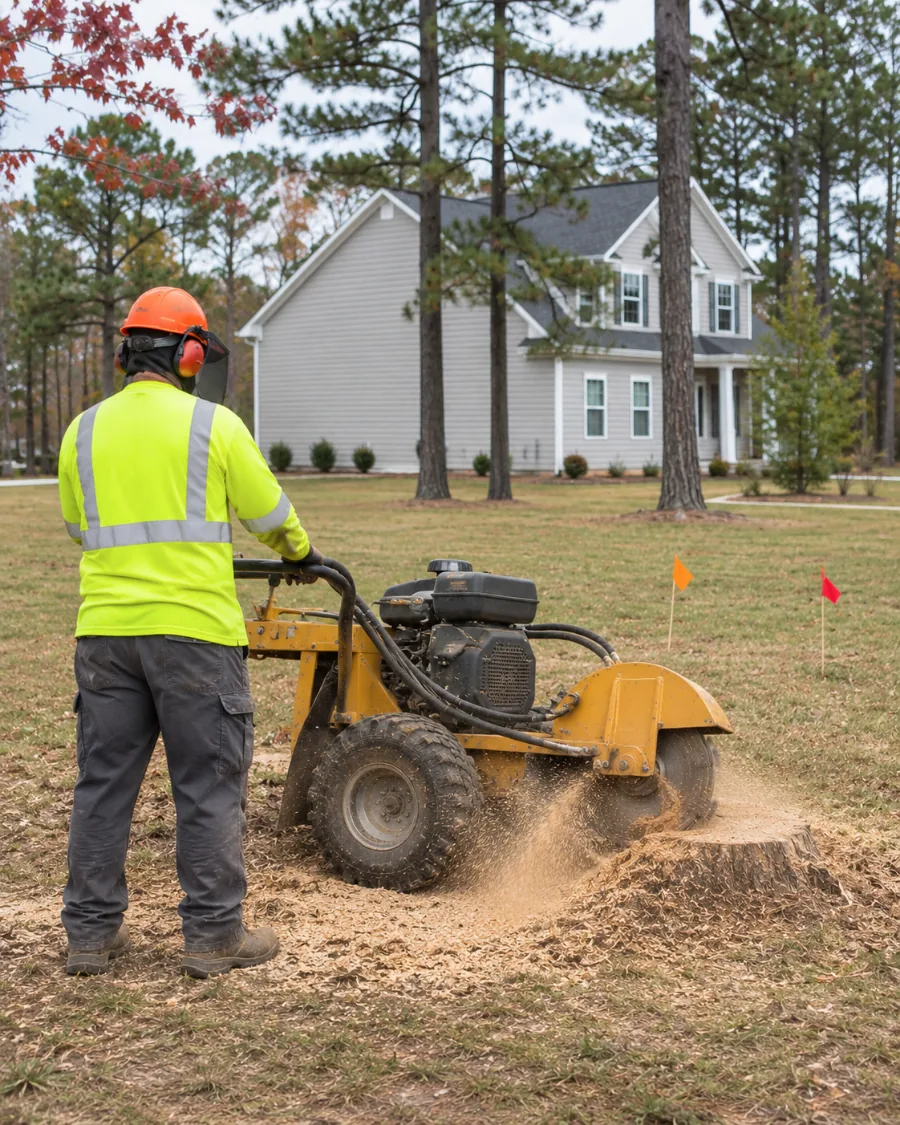
Grind it or pull it?
- Grinding uses a toothed wheel to chew the stump down below grade, leaving the roots in the soil and a pile of grindings. It suits lawns, field edges, lanes, and anywhere nothing heavy will be built.
- Pulling uses an excavator to dig out the stump and its main roots. It's the choice where a house pad, a driveway, or fill will go. It leaves a hole to backfill and a stump that still has to be ground or hauled, since burning it isn't allowed.
One approach on a new house lot is to pull stumps from the footprint and drive and grind the rest. Ask for those two parts priced as separate lines. Lot clearing explains the full sequence.
Call Miss Utility first
Miss Utility, the one-call center for Delaware, Maryland, and D.C., handles locate requests here. Its homeowner page says notice must come "not less than 2 working days, but no more than 10 working days ahead of planned excavation or demolition," and that a request is processed "regardless of excavation depth." Call 811 or file online. Utilities mark their lines by color: red for electric, yellow for gas, orange for communications, blue for water, and green for sewer.
Private lines aren't marked. Miss Utility lists well and septic systems and their power service, water and sewer pipes from the meter to the house, invisible fencing, and sprinkler systems as the owner's responsibility, with a private locating company as the answer. On a rural lot, that can be most of what's buried near the house.
Stumps near the septic system or well
Before grinding near the house, find the septic tank, the lines, and the drainfield, and mark them. DNREC has an online lookup for septic site evaluation reports that can help on a newer system, and its septic program is at 302-739-9947. Mark the well and its power line too. Keep the grinder and any heavy machine off the drainfield.
Stumps in a tax ditch right-of-way
DNREC's tax ditch right-of-way fact sheet says trees there can be flush cut to the top of the soil, but stumps cannot be removed. That rules out pulling, and before grinding inside a right-of-way, ask the Tax Ditch Program (302-855-1930) what's acceptable. The state map at de.gov/taxditchmap shows whether a right-of-way crosses your land. See wet lots and tax ditches.
What's left afterward
Grinding leaves a mound of wood chips mixed with soil. It can be raked back into the hole, spread as mulch, or hauled. If it leaves the property, it goes to a yard-waste site, since DNREC says yard waste is banned from all Delaware landfills. Ask whether the price includes filling the hole with soil, leveling, and seed, and how deep the wheel will go below grade.
What stump grinding costs
HomeAdvisor's stump grinding guide (checked October 2026) gives a national average of $250, with a normal range of $120 to $500. Its per-inch rate is $2 to $5 of stump diameter; it notes that a single stump often carries a minimum of $100 to $150, and it prices each added stump at $40 to $75. Angi's land clearing guide (checked October 2026) lists $120 to $400 per stump for grinding and $100 to $150 per stump for removal.
A worked example (our arithmetic). Three pine stumps measuring 20, 24, and 30 inches add up to 74 inches of diameter. At $2 to $5 an inch that's $148 to $370, before any minimum, cleanup, or travel charge. On a cleared lot with dozens of stumps, a contractor may price by the hour or the job instead, so get the count and sizes in writing. These are national figures; the written quote for your yard is the number that counts. The cost guide compares more prices.
Questions to settle before work starts
- Which stumps, by size and location, and how far below grade each will be ground.
- Whether grindings are raked back, spread, or hauled, and who pays drop-off fees.
- Who requests the Miss Utility locate, and who finds private lines.
- How the machine gets to the stumps without crossing the drainfield or soft ground.
- Whether any stump sits in a tax ditch right-of-way.
Stump questions
How deep does a stump grinder go?
It depends on the machine and the job. Agree on the depth below grade in writing, especially where a lawn, a garden, or a planter will run over the spot.
Can a contractor grind stumps in a tax ditch right-of-way?
Stumps can't be removed there under DNREC's fact sheet. Ask the Tax Ditch Program, 302-855-1930, before any grinding inside a right-of-way.
Do the grindings have to be hauled away?
No. They can go back in the hole or be spread around the yard. If they are hauled, they go to a yard-waste site, not the landfill.
Does a single stump really need a Miss Utility ticket?
Yes. Grinding goes below the surface, and Miss Utility processes requests regardless of excavation depth. Allow at least 2 full working days.
How the referral works
Tell us how many stumps, roughly how big, where they are, and whether a septic system, a well, or a ditch is nearby. One independent contractor who grinds stumps in your part of Sussex County gets the request, looks at the job, and gives you a written price. Hiring them is up to you, and the referral costs nothing.
Have land in Sussex County that needs clearing?
Call or send a few details. One independent contractor gets your request, and the referral costs you nothing.