
Forestry Mulching in Sussex County, DE
Forestry mulching in Sussex County, Delaware suits both the land and the law. The ground is flat and mostly sandy, the understory beneath the loblolly pines is often a thicket of holly, sweetgum, red maple, and vines, and the state doesn't allow land-clearing debris to be burned unless the clearing is for farming. A mulcher grinds standing brush and small trees into a layer of chips right where they grew, so there's no pile left behind. Here's where it works, where it doesn't, and what national guides say it costs.
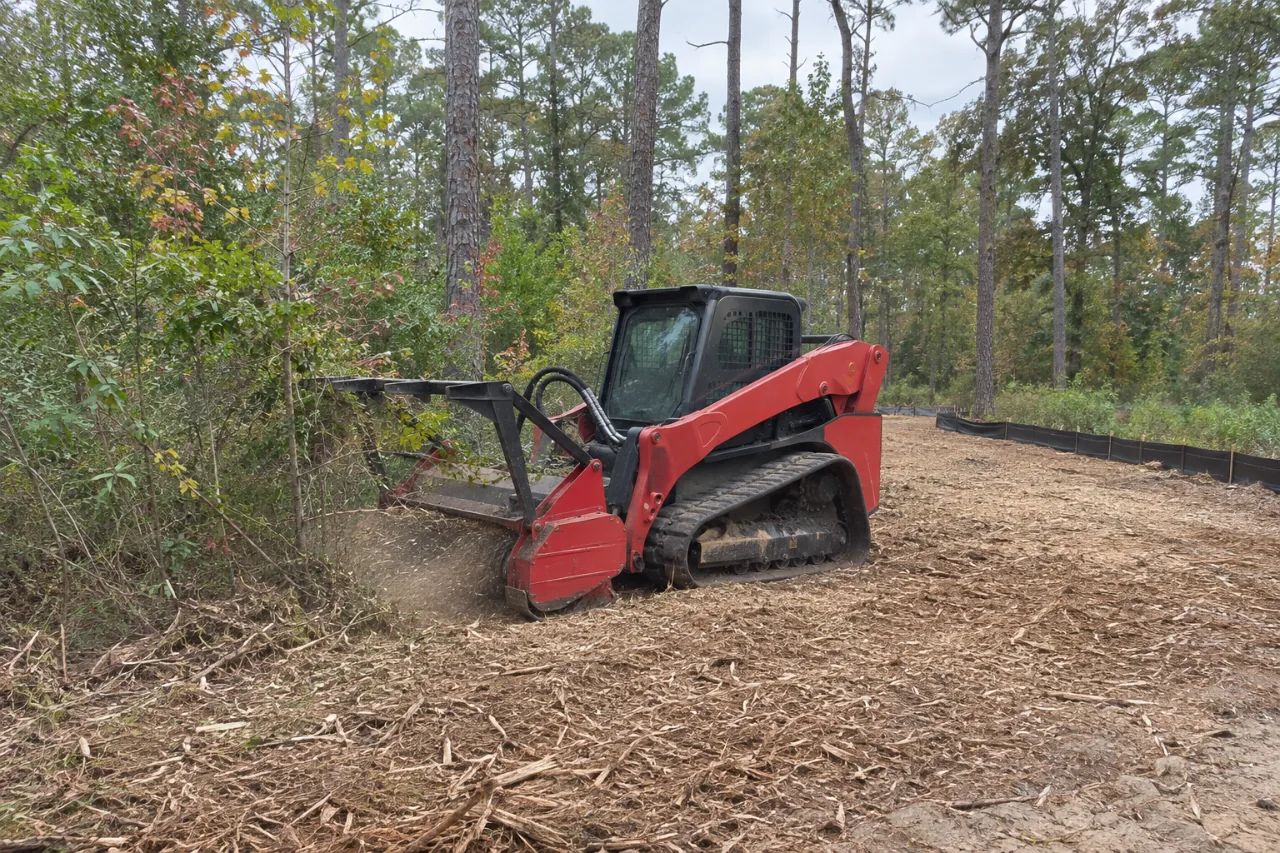
What a mulcher actually does
A forestry mulcher is a spinning drum or disc lined with steel or carbide teeth, mounted on a track loader, an excavator, or a purpose-built tracked carrier. The operator walks it into standing brush and small trees, and the head shreds them from the top down until only chips and low stubs are left. The roots stay in the ground. How big a trunk it can take depends on the head and the machine behind it, so that's a question for the contractor, not a fixed number.
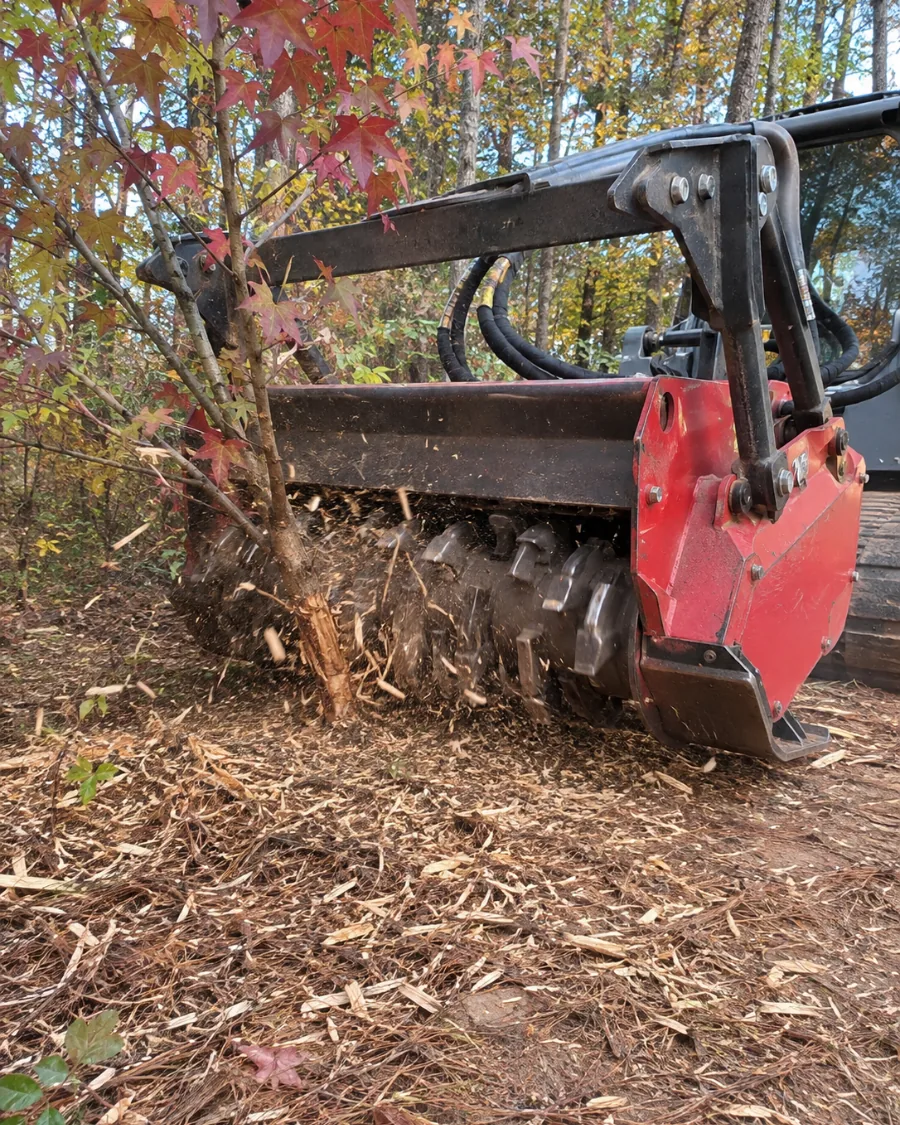
Because the material never leaves the spot where it grew, mulching skips the steps that cost the most on a no-burn site: piling, loading, trucking, and paying to drop off brush somewhere else.
Why it fits a county where burning is out
DNREC's open burning page lists "burning material generated from land clearing, except for agriculture" as always prohibited in Delaware, and most other open burning is off-limits from May 1 through September 30. Brush that gets cut and piled has to be ground on site or hauled away, and DNREC notes that yard waste is banned from all Delaware landfills, so it goes to a yard-waste site instead. A mulcher avoids most of that by leaving the chips on the ground. Debris without burning compares the options.
Jobs it handles well here
- Underbrush beneath pines you want to keep. Holly, sweetgum and red maple saplings, greenbrier, and honeysuckle come out; the loblollies and good oaks stay. See underbrush clearing.
- The rest of a house lot. Mulch the acreage outside the footprint and drive, and grub only where the house sits. See lot clearing.
- Field edges and hedgerows that have crept into cropland. See field edges and hedgerows.
- Lines and access. Opening a property line for a surveyor, or paths so a soil scientist can reach the septic test area.
- Overgrown lots that need to look kept again, or a buffer of woods thinned so you can see through it.
Where mulching falls short
- Under a slab, driveway, or fill. Mulching leaves stumps and roots behind. Wherever something will be built or paved, the stumps are usually dug out instead.
- Wet ground in winter and spring. NRCS describes Fallsington soils, common on low flats and in swales, as poorly drained; their water table can rise to within a foot of the surface between December and May. Ask the contractor how the machine handles soft spots and when your low ground is likely to be firm.
- Along a tax ditch. DNREC's right-of-way fact sheet says trees in a tax ditch right-of-way can be flush cut to the top of the soil but stumps can't be removed, and it asks owners to keep yard waste away from the ditch and out of the right-of-way so it doesn't wash in and block it. Ask what will happen to the chips there. The Tax Ditch Program is at 302-855-1930.
- Wetlands. Low woods with standing water may be regulated. Call DNREC's Wetlands and Waterways Section, 302-739-9943, before clearing them. Wet lots and tax ditches explains who regulates what.
- Big trees. Mature pines and hardwoods too large for the head get felled with a saw first. On a larger tract they may be worth selling; the Delaware Forest Service offers sample timber sale contracts and lists of potential buyers.
What comes back after mulching
Mulching takes off the top growth and leaves the roots, so anything that grows back from roots or stumps can return. Cut sweetgum and red maple can send up sprouts, and vines are stubborn. Multiflora rose and Japanese honeysuckle are both on Delaware's invasive plant list. Plan for follow-up, whether that's a mower pass a few times a season, a second light mulching, or spot treatment of the worst patches. For questions about herbicides, the Delaware Department of Agriculture's pesticide line is 302-698-4571.
Does a mulching job need a plan?
The state requires an approved sediment and stormwater plan before anyone disturbs land, with an exemption for work under 5,000 square feet. If the mulching is part of building a house, the county's Residential Standard Plan is needed anyway. If you're only mulching brush and leaving the roots, ask the Sussex Conservation District, (302) 856-2105, whether your job counts as land disturbance. The permits guide lists every threshold.
What forestry mulching costs
HomeAdvisor's forestry mulching guide (checked October 2026) gives a national average of $500 per acre, with most homeowners paying $400 to $1,500 an acre. Hourly, underbrush and small trees run $125 to $200, and heavy, dense brush climbs to $200 to $400.
Two quick examples (our arithmetic). Two acres at $400 to $1,500 an acre comes to $800 to $3,000. An eight-hour day at the underbrush rate of $125 to $200 an hour comes to $1,000 to $1,600. Thick holly and greenbrier push a job toward the dense-brush end. None of these are Sussex County prices; the contractor's written quote is. See the cost guide for more.
Getting the site ready
- Tie bright flagging on every tree that stays: pines, oaks, the hollies you like.
- Mark the well, the septic area, any buried wires you know about, and the property corners.
- If stumps will be ground below the surface, that's digging: request a Miss Utility locate by calling 811 at least 2 full working days ahead.
- Agree in writing on the area, how close the head works to kept trees, and what happens to chips near a ditch or drive.
Mulching questions
How thick a tree can a forestry mulcher take?
It depends on the head and the carrier, so ask the contractor what their machine handles. Trees over that size get cut with a saw first, and the logs are kept, sold, or hauled.
Can mulching work around hollies and oaks that should stay?
Yes, if they're marked. Flag each keeper, walk the job with the contractor before the machine starts, and put the working distance from those trunks in the agreement.
Is mulching allowed in a tax ditch right-of-way?
DNREC's fact sheet allows trees there to be flush cut, but stumps can't be removed, and yard waste should be kept out of the right-of-way. Call the Tax Ditch Program, 302-855-1930, before working along a ditch.
What time of year suits forestry mulching?
Since nothing gets burned, the season matters less for the brush than for the ground. Low, poorly drained spots are wettest from December to May, so ask the contractor when your land is likely to carry a machine without rutting.
How the referral works
Tell us roughly how many acres need mulching, what's growing, which trees stay, and whether a ditch or wet spot runs through it. One independent contractor who mulches in your part of Sussex County gets the request, walks the land, and gives you a written price. The choice to hire them is yours, and there's no cost for the referral.
Have land in Sussex County that needs clearing?
Call or send a few details. One independent contractor gets your request, and the referral costs you nothing.