
Field Edge & Hedgerow Clearing in Sussex County, DE
On Sussex County, Delaware farms, the woods don't stay where they were. Hedgerows of red cedar, sweetgum, cherry, and multiflora rose push into the corn and soybeans, shading the outside rows and catching on equipment, and the banks of field ditches fill in with brush. Field edge and hedgerow clearing is farm work with its own rules: a separate exemption in the state stormwater law, a narrow allowance for burning, and tax ditch rights-of-way where stumps have to stay in the ground. Here's how it fits together.
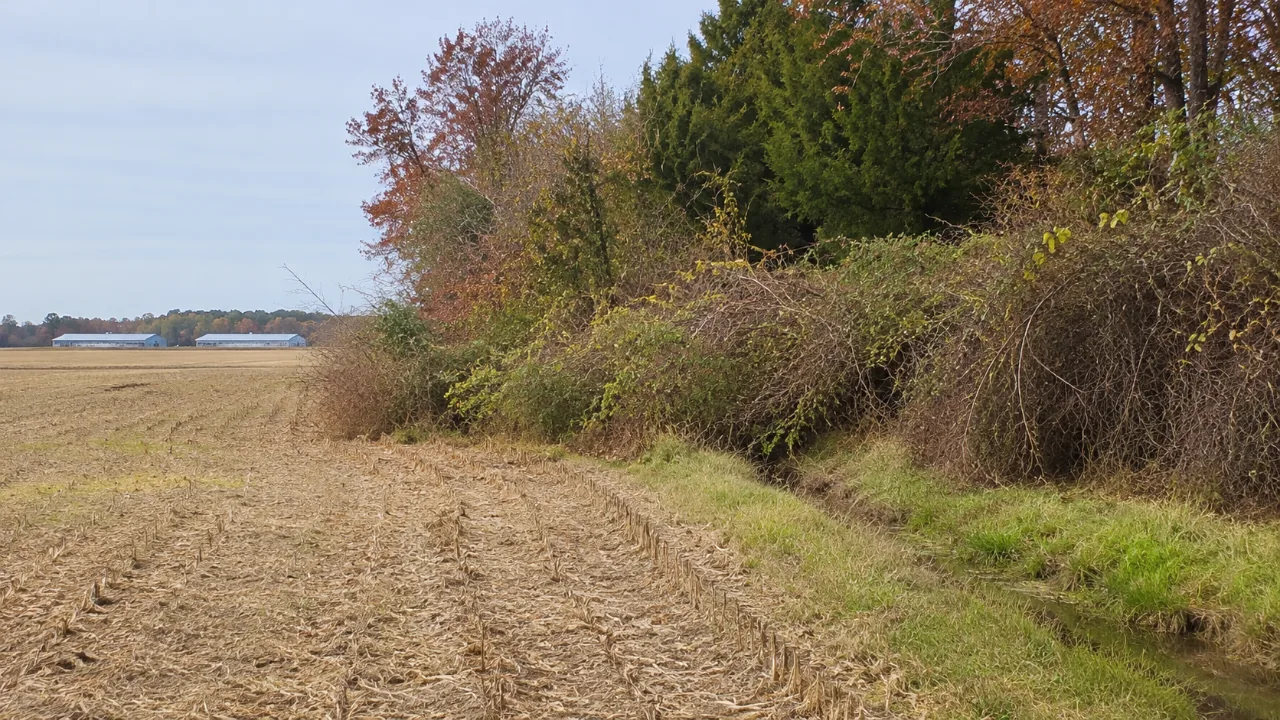
What owners usually want back
- The outside rows of a field, and room to turn a planter or combine at the ends.
- A ditch bank clear enough for the tax ditch managers to mow and maintain.
- A lane along the woods to reach a back field, a woodlot, or a hunting spot.
- A narrower, tidier hedgerow, rather than none at all. Some owners keep a strip of trees on purpose.
Delmarva farm ground is mostly flat and sandy. NRCS notes that drained Fallsington soils grow corn, soybeans, and small grains, and Rosedale soils, described from Sussex County, are mainly in cultivated crops. That flat, open ground is good for machines, but the low, poorly drained spots along ditches have a seasonal high water table near the surface from December to May.
Farm clearing under the stormwater rules
Delaware's Sediment and Stormwater Regulations exempt "agricultural land management practices having a soil and water conservation plan," unless a new or updated plan is needed and the owner has refused to get one. Converting woods to new cropland is handled a little differently: the Delaware Forest Service's erosion regulations say that once forest land is converted, clearing falls under DNREC's sediment and stormwater law, and that for cropland "the designated agencies are the local Conservation Districts in each county." The owner or operator is expected to get approval before starting.
In practice: before trimming back a field edge or turning a wooded strip into crop ground, call the Sussex Conservation District. Its stormwater program line is (302) 856-2105; ask who handles farm conservation plans. If the clearing is for a building, such as a poultry house or an equipment shed, it's construction, not farming. DNREC has separate standard plan forms for poultry house construction and agricultural structures, listed on its applications page.
Burning on the farm
This is the one place Delaware still allows land-clearing brush to be burned. DNREC's agricultural burning page allows burning for "land clearing for agricultural operations," including clearing land not farmed before for a new agricultural use. The conditions are strict:
- Apply through DNREC's ePermitting system with a set burn date, allow five to seven business days, and wait for written approval by email.
- Notify the Sussex County Fire Board (302-856-6306) with your approval number before lighting.
- Burn only from 8 a.m. to 4 p.m., and never from May 1 through September 30 or on Air Quality Action days.
- No burning of brush from clearing for structures, farm buildings included, and none where houses or other structures will be built within five years.
Mulching or grinding the hedgerow avoids the burn approval entirely. Debris without burning compares the options.
Tax ditches along the field
Where a field edge runs along a tax ditch, a drainage channel maintained by a legally formed association of the landowners in its watershed, the ditch has its own rules. DNREC's tax ditch questions and answers say channels range "from six to 80 feet wide, and two to 14 feet deep." Along each one is a right-of-way, an easement that lets the association get equipment in and spread what it cleans out of the ditch. Its width varies, measured from the top of the bank or the ditch centerline; the state's tax ditch map at de.gov/taxditchmap shows it.
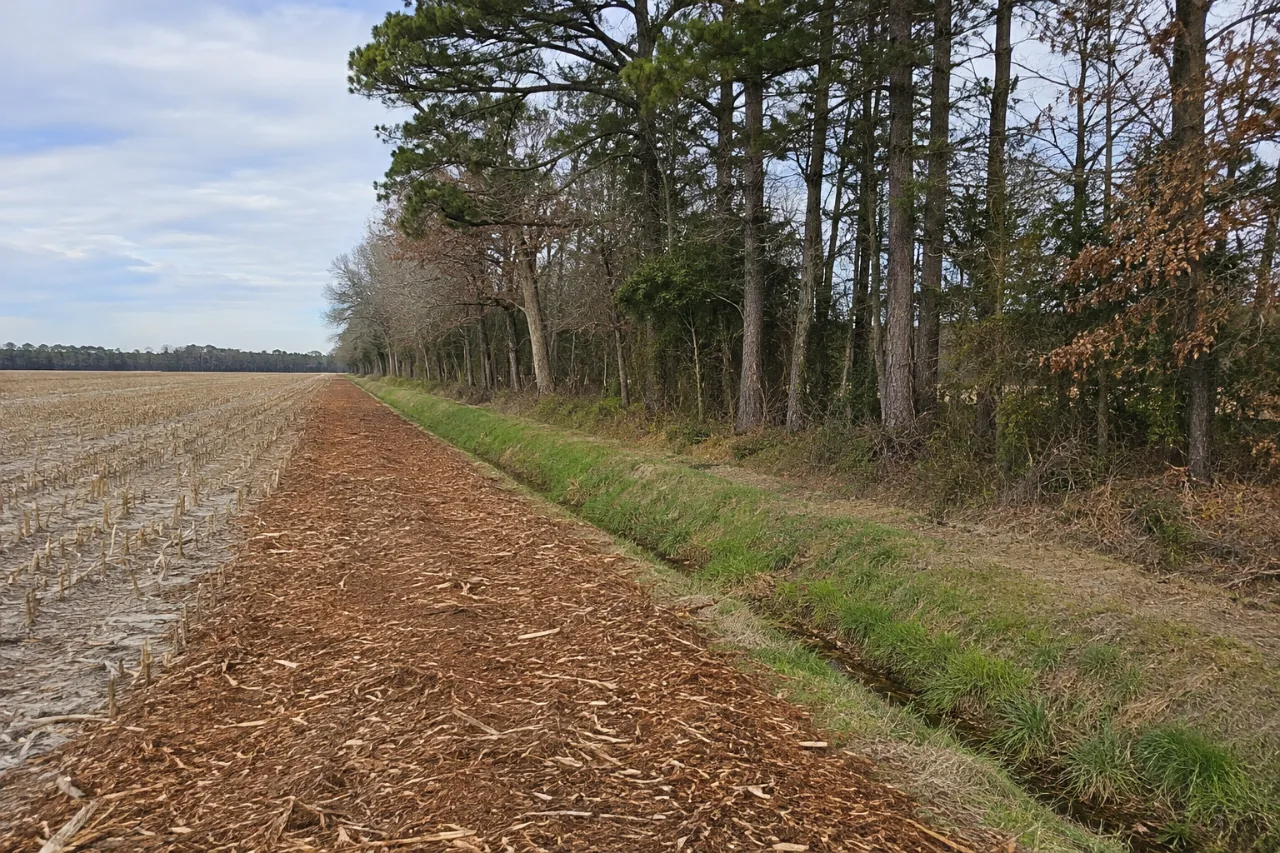
Clearing inside that right-of-way has firm limits under DNREC's fact sheet and land development guidelines:
- Trees can be flush cut to the top of the soil, but stumps cannot be removed.
- The right-of-way "must remain traversable for mowing, large maintenance equipment and/or disposal of soil," so no brush piles, stockpiles, or silt fence across it.
- Keep yard waste and brush out of the right-of-way so it can't wash into the ditch.
- Mow with the blade high, and skip broad-spectrum herbicides there.
- Clearing or digging in the ditch channel itself can need approval from the Conservation District, DNREC, or the U.S. Army Corps of Engineers.
Call the Tax Ditch Program at 302-855-1930 before machines work along a ditch.
How a hedgerow comes out
- Mulching the face. A forestry mulcher can cut a hedgerow back to a straight line in one pass, leaving chips and low stumps. It suits grass edges, lanes, and ditch banks. See forestry mulching.
- Pulling and grinding. Where the ground will be tilled or planted, stumps and big roots are usually dug out or ground well below the surface, then the ground is smoothed. Outside any tax ditch right-of-way only.
- Felling the big trees first. Larger cedars, oaks, and pines are cut with a saw and kept, sold, or ground.
Before a timber harvest of an acre or more, operators and buyers must give the Delaware Forest Service written notice at least 10 business days ahead. The Forest Service can also help with timber sale contracts and buyer lists.
What field edge clearing costs
National guides price this the same way as other clearing. HomeAdvisor (checked October 2026) lists forestry mulching at $400 to $1,500 an acre, or $125 to $200 an hour for underbrush and $200 to $400 an hour for heavy brush.
A worked example (our arithmetic). A hedgerow 1,000 feet long that has spread 30 feet into the field covers 30,000 square feet, about 0.69 acre. At HomeAdvisor's per-acre range that is roughly $280 to $1,030 for mulching alone. Pulling stumps for cropland, felling big trees, and work beside a tax ditch add time; one move-in for several field edges spreads the trailer cost. The contractor's written quote is what applies. See the cost guide.
Field edge questions
Does clearing a hedgerow on a farm need a plan?
Farm land management practices with a soil and water conservation plan are exempt from the state's sediment and stormwater rules, and converting woods to cropland goes through the Conservation District. Ask the Sussex Conservation District which applies before the work starts.
Can the brush from a field edge be burned?
Possibly, as agricultural burning with DNREC's written approval, outside May 1 through September 30, between 8 a.m. and 4 p.m., after notifying the Sussex County Fire Board. Not if a house or other structure will be built there within five years.
Can stumps be pulled along a tax ditch?
Not inside the right-of-way. DNREC allows trees there to be flush cut but says stumps cannot be removed. Outside the right-of-way, stumps can come out like anywhere else.
What time of year suits field edge clearing?
Between harvest and planting the field is open for machines. Low ground along ditches is wettest from December to May, and any agricultural burning has to happen outside May through September, so plan around both.
How the referral works
Send the farm's general location, roughly how many feet of hedgerow or field edge, whether a tax ditch runs along it, and whether the ground will be cropped afterward. One independent contractor who does farm clearing in your part of Sussex County gets the request, walks the edges, and gives you a written price. It's your choice whether to hire them, and the referral costs you nothing.
Have land in Sussex County that needs clearing?
Call or send a few details. One independent contractor gets your request, and the referral costs you nothing.